How to Convert to Judaism: An Honest Guide
One road. Many reasons for walking it.
Judaism does not seek converts. It also does not turn away a sincere soul. If you have been circling this question for months or years, this is not a sales page, it is a description of what the road actually looks like, who decides, how long it takes, and what happens to the life you already have.
Who actually converts? People who have been learning for years, people who married into a Jewish family, and people who simply could not stop reading.
There is no single profile and no standard story. What the sincere ones share is that the question stopped being theoretical. Jewish tradition treats that seriously, which is why the road is deliberately slow, and why it is walked with a rabbi rather than completed on a website.

Why This Road Is Walked With Someone
Search results will hand you a checklist. A checklist is not the thing. Conversion to Judaism is a change of life, and the people who complete it almost always did so alongside a teacher who knew them by name, watched them live the material, and told them the truth about what they were seeing.
Here is what that actually means in practice:
The road is real, and it is walked with someone
There is no form to fill out and no ceremony you can book. Conversion to Judaism, giyur in Hebrew, is not a procedure you complete, it is a relationship you build. You learn with a rabbi, you live the material, and in time a beit din, a rabbinical court of three, confirms what your life already shows.
Nobody is asked to become Jewish
The Torah does not ask everyone to become Jewish. Non-Jews have their own God-given path, and Jewish tradition sees it as a beautiful and legitimate path to God in its own right. That means conversion is not a promotion and not a rescue. It is a specific calling, and it belongs to the person who has it.
You are allowed to take your time
Don’t worry, nothing has to be decided this year. Most people who eventually convert spent a long stretch simply learning, without a decision hanging over every class. Understanding comes first. The rest follows or it does not, and both of those are honest outcomes.
A calling is not an emergency. It is a direction.
What the Road Actually Involves
People searching for how to convert to Judaism are usually looking for a checklist, and the honest answer is that there is no universal one. Requirements differ between communities and between rabbinical courts, and any page that hands you a fixed timeline is guessing. What follows is not a promise about your case, but what the road involves nearly everywhere, described plainly, so you can recognize where you are on it.
- 1. The foundationsWho God is in Jewish understanding, and why Judaism insists on a direct relationship without substitutes or intermediaries.
- 2. Torah and its literatureNot only the Hebrew Bible but the tradition that carries it, read the way it has actually been read for three thousand years.
- 3. Shabbat in practiceThe seventh day is not a rule about rest, it is a weekly rehearsal of what the world is for. You learn it by keeping it.
- 4. Kashrut, day to dayWhat a Jewish kitchen is, why it works that way, and how people manage it in an ordinary house on an ordinary budget.
- 5. The Jewish yearFestivals, fasts and cycles, learned in sequence, because a year lived once teaches more than a year described.
- 6. Learning with a rabbiConsistent study over time with someone who knows you, not a course you complete and forget.
- 7. Living in a communityAttending, hosting, being hosted, being missed when you are not there. Judaism is not practiced alone.
- 8. The beit dinA rabbinical court of three that meets you, asks you real questions, and confirms that this life is already yours.
- 9. Immersion in a mikvahA pool of natural water, and the moment the tradition marks as the actual transition.
- 10. Brit milah or hatafat damFor men, circumcision, or a symbolic drawing of blood where circumcision has already occurred.
- 11. How long does it take?Commonly a year at minimum and often several. Not a delay tactic; a year is the smallest unit that contains a whole Jewish calendar.
- 12. Is it different for women?The learning is the same. The physical requirements differ, since brit milah applies only to men.
- 13. What about my family?This is the question that stops most people, and it deserves a real conversation rather than a paragraph. Bring it early.
- 14. Will I be fully Jewish?Yes. A convert is a Jew without qualification, and speaking badly of a convert’s origins is itself a Torah prohibition.
- 15. Can I do this online?You can learn online, and many people start there. The confirmation itself happens with people, in person, because it is about a life and not an exam.
Watch the Road, Start to Finish
Rabbi Taylor has walked this road with people for years. Below is the full four-part series on what conversion to Judaism really involves, followed by a conversation with a convert and a four-part Q&A on the part almost nobody prepares you for, which is life after the beit din.
Part 1: The Journey Begins
Where this starts for most people is not a decision, it is a question that will not go away. This first part deals with the moment before the road, when someone realizes their current understanding of God no longer holds up in their life and they do not yet know what replaces it.
Rabbi Taylor lays out what sincerity looks like from a rabbi’s side of the table, why Jewish courts traditionally turn an applicant away more than once, and why that refusal is not rejection but a test of whether the desire survives contact with reality.
Part 2: What It Really Means to Become Jewish
Becoming Jewish is not adopting a set of beliefs, it is joining a people and accepting the obligations that come with them. This part draws the distinction that most seekers miss. You are not signing a doctrinal statement, you are entering a covenant that began at Sinai and has been carried by families ever since.
Rabbi Taylor explains why that framing changes everything about how the learning is done, and why a convert is counted as a child of Abraham from the moment of immersion.
Part 3: Walking the Road
The practical middle of the journey, which is also the longest part and the least discussed. What a week of observance actually looks like before anything is official, how people handle work, family and food while they are still learning, and what a rabbi is watching for during that time.
The theme here is that Judaism is not learned from a list. The practical implementation can only be learned from a proper teacher who specializes in these matters, and lived alongside people who are already living it.
Part 4: Finding Your Calling
The closing part asks the question the whole series has been circling. Not “can I convert” but “is this mine”.
Rabbi Taylor talks about the difference between attraction to Judaism and a calling to it, why some sincere people are guided toward the Noahide path instead and are not lesser for it, and how a person comes to a settled answer rather than an anxious one.
A Convert Asks the Question Behind the Question
A short and unusually personal conversation. A woman who has already converted asks Rabbi Taylor about the sense that her Jewish life was not new but recovered, a feeling many converts describe and few say out loud.
Whatever you make of the metaphysics, the conversation is worth hearing for what it shows about how converts are received in Jewish tradition, which is as Jews, fully, with a past that is honored rather than erased.
After the Beit Din, Part 1
Almost every resource on conversion ends at the mikvah. This four-part Q&A begins there.
Part one covers the first months of being Jewish rather than becoming Jewish, including the strange quiet that follows a long process ending, and the practical questions that suddenly matter, such as how to introduce yourself, what to say when someone asks where you are from, and how to handle a family that is still adjusting.
After the Beit Din, Part 2
Relationships and community. How converts build a social life inside a community they joined as adults, what to do when a well-meaning question lands badly, and how Jewish law protects a convert from having their origins raised against them.
Rabbi Taylor is direct about the gap between what the law requires and how people sometimes behave, and about what to do when you meet that gap.
After the Beit Din, Part 3
Family, marriage and the generations that follow. Questions about non-Jewish parents and siblings, honoring them within Jewish law, what happens at their life events and at their funerals, and how a convert’s children are situated.
This is the part of the material people are usually too polite to ask about, answered at length.
After the Beit Din, Part 4
The long view. Growth after the milestone, finding a rabbi you keep rather than a rabbi you finished with, and what a Jewish life looks like ten years in.
The through line of all four parts is that conversion is not the destination, it is the door, and the person who keeps learning afterward is the one for whom it was real.
WHAT ARE PEOPLE SAYING?

“I wasn’t sure if The Ark was really meant for someone like me. I’m not Jewish and wasn’t sure if I’d be welcomed. But from the very first session, I felt seen, respected, and spiritually fed in a way I hadn’t experienced before.”

Jessica Lynn Carter
“I always sensed there was more to the Bible than I had been taught. The Ark is where I finally started getting the full picture. It’s been a humbling and thrilling journey.”

Jace Rhodes
“I was nervous about diving into Torah learning without any formal religious training. But The Ark made everything approachable, deep, and relevant. Now I can’t imagine my mornings without it.”

Brian Keaton
“I worried I wouldn’t understand the Jewish texts and perspectives. But every session in The Ark helps me connect spiritually, emotionally, and intellectually. I’m learning more in a few months than I did in years of church study.”

Rebecca Lynn Hollowell
“As someone raised in a Southern Baptist home, I had a lot of questions. I was hesitant to explore anything outside what I was taught growing up. The Ark has helped me connect the dots between what I always believed and what was hidden in plain sight.”

Amanda Jo Ramirez
“I didn’t want to feel like an outsider or someone peeking in where I didn’t belong. The Ark erased all those feelings. It’s a sacred space for truth seekers, no matter your background.”

Tyrell Bowen
Questions People Actually Ask
You begin by learning with a rabbi. There is no application and no central office. You find a teacher, you study consistently, and you begin living the material while you learn it. Over time, usually a year at minimum and often longer, your rabbi guides you toward a beit din, a rabbinical court of three, which meets with you and confirms the conversion.
Men undergo brit milah, circumcision, or a symbolic procedure where circumcision has already taken place. Everyone immerses in a mikvah, a pool of natural water, and that immersion is the moment the tradition marks as the transition. What makes the difference is not the sequence, it is the relationship with a teacher who knows you well enough to guide you honestly.
A year is the usual minimum and several years is common. That is not an obstacle course. A Jewish year contains the full cycle of festivals, fasts and seasons, and living through it once is the smallest honest sample of the life you are considering.
Communities and rabbinical courts set their own expectations, and anyone who promises you a fixed timeline is guessing at best. The right question is not how fast this can be done, it is whether the life is becoming yours.
No. Judaism does not seek converts. The Torah does not ask everyone to become Jewish, and non-Jews have a full and God-given path of their own that Jewish tradition regards as a beautiful and legitimate path to God in its own right.
A sincere person is never turned away, but they are also never recruited. Some students do eventually decide to explore conversion, and that is a separate journey, not a general goal.
Yes, and many people who convert do. Coming to Judaism from another tradition is not a mark against you, and your previous seriousness about God is usually an asset rather than a liability.
What the process asks is not that you be ashamed of where you came from, it is that you take on the covenant of the Jewish people fully and without reservation. Those are different things. Your history is part of how you arrived, and Jewish law explicitly forbids anyone from holding it against you afterward.
The learning, the community life and the beit din are the same. The physical requirement differs: brit milah, circumcision, applies only to men, or hatafat dam brit, a symbolic drawing of blood, where a man is already circumcised. Everyone immerses in a mikvah.
Practical questions about family life, modesty and observance come up differently for different people, which is one more reason the guidance has to be personal rather than generic.
You will be Jewish, fully and without qualification. A convert is counted as a child of Abraham and Sarah, and the Torah repeatedly and specifically commands care for the convert. Reminding a convert of their origins in order to diminish them is itself a prohibition.
People are people and you may occasionally meet someone who has not internalized that, but the tradition itself is not ambiguous. On this the law is a flat statement, not a nice sentiment.
You can do a great deal of the learning online, and for people far from a Jewish community that is often how it begins. Rabbi Taylor teaches members around the world.
The confirmation itself is not online. A beit din meets you in person and immersion in a mikvah happens in a physical place, because the tradition is confirming a life rather than grading an exam. Starting online is normal. Finishing online is not a thing.
Then you have learned, and that has value in itself. Many members of the Ark study Torah for years with no intention of converting, and Rabbi Taylor teaches them the same way he teaches everyone else.
The Noahide path, the moral covenant God gave to all humanity after the Biblical flood, is a complete relationship with God and not a consolation prize. Arriving at a clear no is a real outcome, and it is a better one than an anxious yes.
Other Questions People Bring Here
Conversion is rarely the first question somebody asks. These two pages cover the ground most readers cross on the way here.
Judaism teaches that a non-Jew does not need to convert to have a share in the world to come. If that is new to you, start here. For some readers it turns out to be the path they were actually looking for.
If you are coming from a Christian background, this question usually needs an answer before anything else can move. Rabbi Taylor gives the Jewish answer plainly, and credits the good that came to the nations along the way.
Learn With a Rabbi Who Knows Your Name
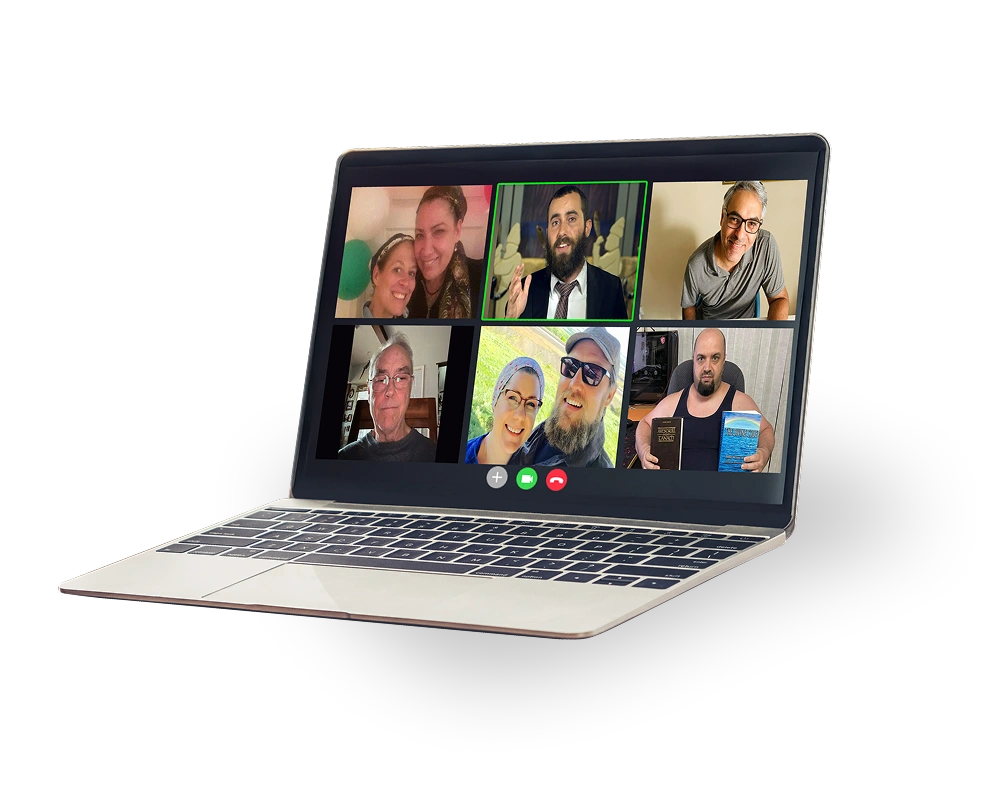
The Ark is not a course with an end date, it is Rabbi Taylor’s global learning community. Members get live classes, a full library you can work through at your own pace, and ongoing access to the rabbi himself, whenever it is convenient for you. It is not a conversion program and it does not promise anyone a beit din date. It is where the learning happens, and where the honest conversation about your own path can start.
Whether you eventually convert, or find that the Noahide path was yours all along, you will not work it out alone.